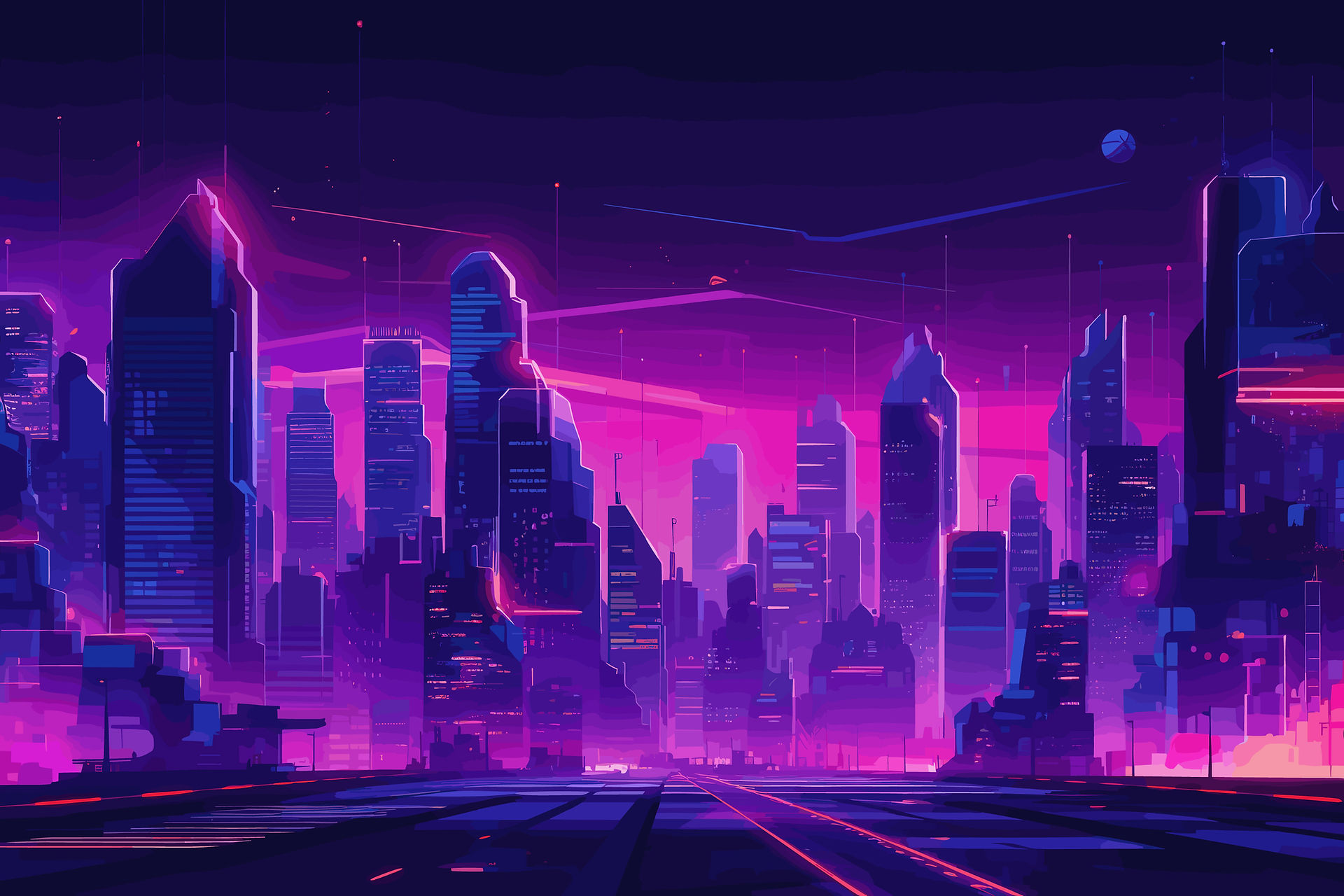
What is Cyberpunk?
Cyberpunk is a subgenre of science fiction that merges high technology with a low-life, dystopian reality, a world defined by the motto “high tech, low life.” It portrays societies where technological advancement coexists with social collapse, corruption, and decay. The genre explores the consequences of technology on humanity, the dominance of megacorporations over governments, artificial intelligence, virtual realities, and individuals resisting oppressive systems.
The term emerged in the 1980s, shaped by groundbreaking works like Neuromancer (William Gibson), Blade Runner (inspired by Philip K. Dick), and Akira (Katsuhiro Otomo). Cyberpunk has since influenced aesthetics, storytelling, and philosophy across cinema, games, anime, music, etc.
At its core, cyberpunk focuses on marginalized antiheroes such as hackers, mercenaries, and outcasts who navigate the underworld of neon-lit cities where identity, power, and information are unstable. However, cyberpunk is not only about neon lights and holographic ads; it is also about urban dystopias, social decay, inequality, and resistance. It envisions a future of technological brilliance contrasted by human and environmental collapse, where cybernetic evolution blurs the line between flesh and machine.
Keywords: high tech low life, urban decay, neon aesthetics, mass surveillance, hacking, artificial intelligence, cybernetics, megacorporations, dystopia, transhumanism, virtual reality, corporate oppression, digital rebellion, synthetic consciousness, underground networks, cyber warfare.
Take some time to explore our Cyberpunk Encyclopedia, dive into the subgenres menu and check out our documentary section on cyberpunk culture to get even deeper into the world of cyberpunk.
Cyberpunk Timeline
1960s-1970s: Foundations of Cyberpunk

1968 – Do Androids Dream of Electric Sheep? (Philip K. Dick)
Philip K. Dick’s novel explores the concept of artificial intelligence and what it means to be human, laying the foundation for cyberpunk themes of identity, consciousness, and the merging of man and machine.

1973 – The Shockwave Rider (John Brunner)
This novel introduces hacking as a form of rebellion, a central idea in cyberpunk where technology becomes both a tool and a weapon. In The Shockwave Rider, John Brunner explores a world shaped by data networks and information control, anticipating many of the themes that would later define the genre.

1977 – Traveller RPG
The Traveller tabletop RPG features themes of high-tech, low-life, and complex politics, introducing the blend of technology and dystopia that would define cyberpunk.

1977 – True Names by Vernor Vinge
Decades before cyberspace became mainstream, True Names envisioned a world where hackers operate in a virtual realm. The novella introduced the concept of online identities, government surveillance, and digital warfare, laying the groundwork for cyberpunk’s vision of the internet.
1980s: The Birth of Cyberpunk

1982 – Blade Runner is released
Blade Runner, directed by Ridley Scott and inspired by Dick’s Do Androids Dream of Electric Sheep?, brings cyberpunk aesthetics to the mainstream with its rain soaked megacityscapes, saturated urban glow, and a society shaped by overwhelming corporate power.

1983 – The term “Cyberpunk” is coined by Bruce Bethke
Bruce Bethke coins the term "cyberpunk" in his short story, capturing the spirit of a subgenre that would soon take shape across literature and film. The term itself blends high technology with countercultural rebellion, hinting at the themes that would come to define the genre.

1984 – Neuromancer (William Gibson)
William Gibson’s Neuromancer defines much of the cyberpunk genre, introducing the concept of "cyberspace" and the hacker as protagonist. It marks the beginning of the genre’s literary dominance.

1987 – Cyberpunk 2020 RPG
Cyberpunk 2020 introduces a detailed world of high-tech and low-life, featuring a dystopian society dominated by corporations. It becomes a seminal tabletop game that influences cyberpunk culture.

1988 – Akira anime is released
Katsuhiro Otomo’s Akira becomes a milestone in cyberpunk anime, blending themes of political unrest, technological excess, and societal collapse with groundbreaking animation. Set in a volatile Neo-Tokyo, the film captures the tension between authority and rebellion, leaving a lasting mark on the genre’s visual and narrative identity.

1989 – Ghost in the Shell manga debuts
Ghost in the Shell explores the concept of AI and the boundaries between humanity and technology, setting the stage for many cyberpunk works in the years to come.
1990s: Cyberpunk Goes Mainstream

1992 – Snow Crash (Neal Stephenson)
Neal Stephenson’s Snow Crash expands the virtual reality and hacking themes of cyberpunk, predicting the rise of the Internet and virtual spaces as places of power and control.

1995 – Ghost in the Shell anime film
The Ghost in the Shell film adapts Masamune Shirow’s manga, presenting a philosophical exploration of AI, consciousness, and the merging of human and machine. Through Major Motoko Kusanagi’s journey, it questions what remains of identity when the line between organic and synthetic begins to dissolve.

1997 – GURPS Cyberpunk banned by the U.S. Secret Service
The GURPS Cyberpunk role-playing game is banned after concerns over its hacking content, reflecting the growing tension between technology and government surveillance.

1999 – The Matrix premieres
The Matrix revolutionizes the cyberpunk genre in cinema, blending mind-bending philosophy, action, and cyberpunk aesthetics to explore themes of control, freedom, and the nature of reality.
2000s-2010s: Cyberpunk Evolves

2002 – Minority Report brings cyberpunk to Hollywood
Based on Philip K. Dick’s short story, Minority Report explores pre-crime, surveillance, and the ethics of technology, continuing the exploration of cyberpunk themes in mainstream Hollywood.

2013 – Elysium by Neill Blomkamp
This dystopian sci-fi film touches on cyberpunk themes like wealth disparity, corporate dominance, and cybernetic augmentation. While the rich live in luxury on a space station, Earth’s poor struggle to survive, and one man’s fight for survival challenges a system built to keep power in the hands of the elite.

2015 – Ex Machina by Alex Garland
Blending psychological thriller with sci-fi, Ex Machina explores AI, consciousness, and autonomy. A programmer is invited to test Ava, a highly advanced AI, but as the experiment unfolds, the line between human and machine becomes dangerously blurred.

2017 – Blade Runner 2049 continues the legacy
The sequel to Blade Runner expands on the original film’s themes of AI, humanity, and corporate control, while refining its visual language for a new generation. Through a slower, more introspective narrative, it deepens the question of what it means to be human in a world shaped by artificial life and fading memories.
2020s and Beyond: The Future of Cyberpunk

2020 – Cyberpunk 2077 is released
Cyberpunk 2077, a highly anticipated open-world video game, immerses players in a sprawling dystopian future, inviting them to navigate themes of transhumanism, corporate dominance, and rebellion. Set in the dense urban chaos of Night City, the game offers a layered look at how power, identity, and technology collide.

2022–Present – The rise of generative AI
The rapid emergence of generative AI tools begins to blur the line between human and machine creativity. From AI-generated art and music to increasingly autonomous systems, concepts once confined to cyberpunk fiction start taking tangible form, raising questions about identity, authorship, and control in a digitized society.

Cyberpunk continues to evolve
As technology advances in real life, the genre remains relevant, offering a reflection on the impact of AI, surveillance, biotech and corporate control in the modern world. New films, games, and literature continue to push the boundaries of what cyberpunk means in a rapidly changing society.