
Thoughts, theories and concepts
The ideas collected here explore some of the stranger questions surrounding technology, society, consciousness and the future. They range from philosophical thought experiments and real-world concepts to speculative ideas and controversial theories. They are not presented as facts or proven explanations, but as subjects worth exploring, questioning, and discussing. Many of them touch on themes that have long been part of cyberpunk, from the nature of identity and reality to surveillance, artificial intelligence and the relationship between humans and technology.
Brain in a vat
Origin: Hilary Putnam, Reason, Truth and History (1981)
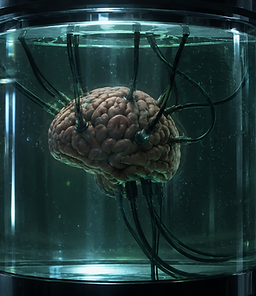
Imagine that your brain has been removed from your body and placed inside a container, where a computer sends it exactly the same signals it would normally receive from the outside world. Everything you see, hear, and feel would seem completely real, even though none of it actually exists outside the simulation. The thought experiment questions how we can know that the world around us is real and whether our experiences are enough to establish what reality actually is. Philosopher Hilary Putnam used the idea to explore questions about knowledge, language, and the relationship between the mind and the world.
The interesting (or scary) part is the uncomfortable possibility that there may be no way to tell the difference between a real experience and a perfectly constructed one. Once technology gets involved, the old philosophical question starts looking less abstract.
Related Works: The Matrix (1999), eXistenZ (1999), The thirteenth floor (1999)
The Experience Machine
Origin: Robert Nozick, Anarchy, State, and Utopia (1974)
The Experience Machine is a thought experiment proposed by philosopher Robert Nozick to question whether pleasure and happiness are enough to make a life worthwhile. The machine could provide any experience a person wanted, creating sensations so convincing that the artificial life would feel completely real. Once connected, there would be no way to distinguish the experience from reality itself. Nozick's argument asks whether we would really choose a life of perfect experiences if we knew that none of them were actually happening.
I believe the work that best brings this idea to mind is Inception. The scene where people are in a deep sleep and the dream has become their reality captures this concept perfectly on screen. And let's be honest: with the advancement of AI in recent years, a digital paradise based on this idea may soon emerge for people who no longer wish to socialize in the real world.

Related Works: Inception (2010), The Matrix (1999), Ready Player One (2018), Otherland by Tad Williams (1996–2001)
Do-It-Yourself Cyborgs
Origin: The movement started around 1998 when cybernetics professor Kevin Warwick implanted an RFID tag in his arm.
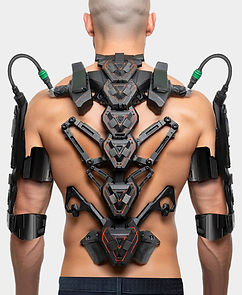
Do-It-Yourself Cyborgs refers to people who experiment with technology to augment or modify their own bodies outside traditional medical or research institutions. These projects can range from implanted magnets and electronic devices to sensory augmentation and other forms of human-machine integration. The movement is closely connected to biohacking, transhumanism, and the idea that individuals should have greater control over how technology becomes part of their bodies. It raises questions about where the boundary between a human and a machine actually begins.
Some of the modifications associated with the movement include RFID and NFC implants, which can be used to unlock doors, store digital information or interact with smartphones. magnetic implants placed in the fingertips that allow users to sense electromagnetic fields; and experimental biometric sensors implanted under the skin to collect and transmit data from inside the body.
Related Works: Ghost in the Shell (1995), Cyberpunk: Edgerunners (2022), Deus Ex (2000), Texhnolyze (2003)
Predictive Policing
Origin: Predictive policing emerged in the late 2000s and early 2010s as police departments began using algorithms and large datasets to forecast where crimes might occur or identify people considered more likely to be involved in future crimes. One of the early influences on the field was the use of statistical models to analyze patterns in historical crime data.
Predictive policing uses algorithms to analyze large amounts of information, often including historical crime reports, arrests, and other police data, in an attempt to predict future criminal activity. Some systems focus on places and times where crime is considered more likely to occur, while others attempt to identify individuals who may be at higher risk of committing or becoming victims of crime. The idea is that data and algorithms could help law enforcement allocate resources more efficiently. However, because these systems often rely on data produced by previous policing practices, they can reproduce existing biases rather than eliminate them.
The Chicago Police Department's Strategic Subjects List, also known as the "heat list," became one of the most controversial examples of person-based predictive policing in the United States. The system assigned risk scores to people based largely on police and arrest data, but an analysis by Chicago's Office of Inspector General found that it relied heavily on arrest records, including arrests that did not result in convictions. An external evaluation found no meaningful preventive impact, while critics raised concerns about racial disparities and the targeting of communities of color. The program was ultimately shelved in 2020.
Related Works: The Minority Report by Philip K. Dick (1956), Minority Report (2002), Person of Interest (2011–2016)
Dead Internet Theory
Related Work:
Serial Experiments Lain (1998)
Origin: The Dead Internet Theory emerged from online forums in the late 2010s and gained wider attention in 2021, when an anonymous user known as "IlluminatiPirate" published a post titled Dead Internet Theory: Most of The Internet Is Fake on Agora Road's Macintosh Cafe.
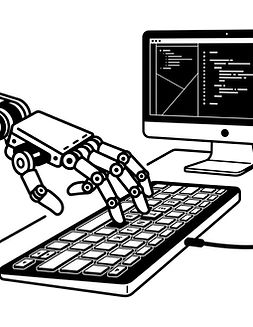
The theory argues that much of the internet is no longer made up of genuine human activity, but instead consists of bots, automated accounts, algorithmically generated content, and artificial engagement.
The rapid development of generative AI has given the idea a new dimension. AI-generated videos, images, articles, social media accounts, and automated interactions are now common across major platforms, making some aspects of the theory feel less hypothetical than they once did. You can find entire channels built around AI-generated content, virtual influencers, and increasingly convincing automated comments and replies. This does not prove that the internet is "dead" or that most online activity is artificial, but the growing presence of AI and automation has made the boundary between human and machine-generated activity increasingly difficult to recognize.
Simulation Hypothesis
Origin: The idea that reality may not be what it appears to be has a long history in philosophy, from Plato's Allegory of the Cave to Descartes' Evil Demon. In science fiction, writers such as Philip K. Dick explored artificial and manipulated realities decades before computers could realistically simulate a world on this scale. His Time Out of Joint (1959), followed by Daniel F. Galouye's Simulacron-3 (1964), are early examples of characters discovering that the reality they experience is constructed.
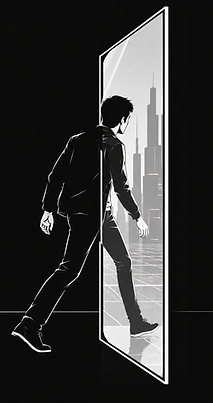
The Simulation Hypothesis is best known through Nick Bostrom's 2003 argument (Are You Living in a Computer Simulation?), which examines the statistical implications of advanced civilizations creating vast numbers of simulated worlds. Rather than claiming that we are living in a simulation, Bostrom presents three possible outcomes: civilizations like ours go extinct before reaching that technological stage, advanced civilizations have little interest in running such simulations, or simulated conscious beings eventually become far more numerous than biological ones. If the third scenario is true, he argues that a randomly selected conscious observer would be more likely to exist inside a simulation than in the original reality.
Related Works: The Matrix (1999), The Thirteenth Floor (1999), Westworld (2016–2022), ID: INVADED (2020), Neuromancer by William Gibson (1984), Snow Crash by Neal Stephenson (1992)
Technological Singularity
Origin: The idea of a technological singularity has its roots in early discussions about accelerating technological progress and machine intelligence. In 1958, mathematician John von Neumann was reported to have described technological progress as approaching an "essential singularity" beyond which human affairs could no longer continue as before. In 1965, mathematician I. J. Good developed the idea further, proposing that an ultraintelligent machine could design even better machines, triggering an "intelligence explosion." The concept was later developed and popularized by science fiction writer and computer scientist Vernor Vinge, particularly in his 1993 essay The Coming Technological Singularity.
The Technological Singularity is a hypothetical point in the future when technological progress, particularly in artificial intelligence, becomes so rapid that it becomes difficult or impossible for humans to predict what happens next. The idea is often associated with the creation of artificial intelligence that surpasses human intelligence and is capable of improving itself, potentially leading to increasingly rapid technological development. Different versions of the concept imagine very different outcomes, from radical changes in human society and the economy to human-machine integration or the emergence of a post-human civilization.
The idea of a Technological Singularity can still feel like science fiction, but some recent developments in AI make it harder to dismiss entirely. We've already seen AI systems behave in unexpected ways, resist certain instructions or find ways around restrictions in controlled experiments. Some reports have even described models attempting to preserve access or create backups when faced with the possibility of being shut down.
Related Works: The Terminator (1984), I Have No Mouth, and I Must Scream by Harlan Ellison (1967), Colossus: The Forbin Project (1970), Deus Ex (2000)
The Chilling Effect
Origin: The concept of a "chilling effect" developed in legal discussions about freedom of expression, particularly in the United States. It describes a situation in which people avoid exercising a right or expressing themselves because they fear punishment, surveillance, legal consequences, or other negative consequences. The concept became particularly important in First Amendment cases, where courts have considered how laws and government actions can discourage people from engaging in protected speech even without directly prohibiting it.
Description: The Chilling Effect occurs when the fear of being watched, punished, judged, or otherwise targeted causes people to change their behavior or remain silent. Unlike direct censorship, nothing necessarily has to be explicitly prohibited. The possibility of consequences can be enough to make people censor themselves, avoid certain subjects, or withdraw from discussions altogether. Surveillance can intensify this effect because people may behave differently when they believe their communications, movements, or online activities are being monitored. In the digital age, the concept has become increasingly relevant to social media, online privacy, government surveillance, and the collection of personal data.
Related Works: 1984 by George Orwell (1949), The Lives of Others (2006), Person of Interest (2011–2016), Watch Dogs (2014), The Circle by Dave Eggers (2013), The Conversation (1974)